


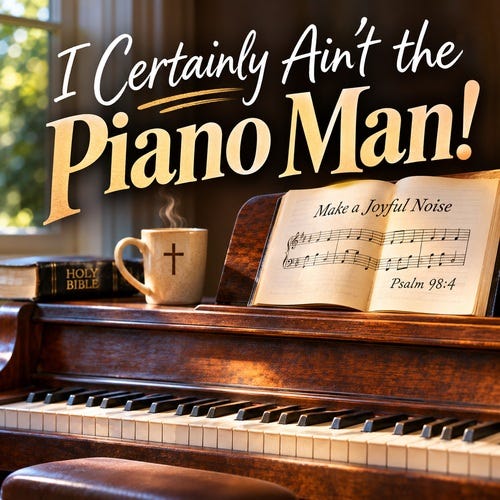
I know exactly what drew me into music in the first place. It was my very own piano!
Now, before you picture some beautiful grand piano sitting in the corner of our living room, let me set the record straight. This was one of those church basement specials. You know the kind. A piano tall enough to give you a nosebleed if you climbed on top of it. The keys were various shades of yellow and beige, with a few of the plastic caps missing here and there. It wasn’t much to look at, but it was mine!
I started piano lessons in first grade with Mrs. Johnson, and for the next nine years, she patiently attempted to turn me into a musician.
Along the way, I even managed to restore my old piano to something resembling its former glory. I replaced the missing key caps with a brand-new package of “real ivory-look plastic.” I dusted it, polished it, and before long, that old piano was looking pretty good!
We even had it tuned annually, which meant that for about two or three months each year, it actually sounded pretty good, too.
Then, as a freshman in high school, I stopped taking piano lessons and started playing the organ. Now THAT was an instrument! Imagine a giant piano on steroids, complete with multiple keyboards and an entire set of keys you were supposed to play with your feet.
Unfortunately, my feet proved to be considerably less talented than my fingers.
Praise God, I was still in my “playing by ear” phase of musical development, so even my feet occasionally listened to my ears. Occasionally.
The Trouble with Playing by Ear
Mrs. Johnson was a wonderful teacher, and her beautiful ebony baby grand piano was a dream to play. For most students, she and that piano were a perfect combination.
But I was the odd one.
You see, whenever I started learning a new piece of music, Mrs. Johnson would play it for me first so I could hear how it was supposed to sound.
What she didn’t realize was that she was helping me develop a terrible habit.
I learned to play by ear rather than by actually reading the sheet music!
Oh sure, if I already knew the piece, the sheet music could help me find my starting notes. It also served as a helpful warning about those dreaded flats and sharps that were lurking ahead.
But for the most part, I played what I heard in my head rather than what was printed on the page.
At the time, none of this seemed to matter much. I played for my own enjoyment and occasionally for the enjoyment of anyone within earshot.
Of course, I realize now that those two groups weren’t necessarily the same people.
For three years, I had the wonderful opportunity to practice on a then-brand-new, 35-rank Schantz pipe organ at my church. And here’s the best part: I had my very own key to the church!
That meant I could practice anytime, day or night.
I became comfortable playing music before and after worship services and during the offering. But accompanying congregational singing? Well, that was another matter entirely.
You see, my rhythm was pretty much my own, and my ears were constantly hearing wonderful, flourish-filled arrangements that weren’t necessarily printed anywhere.
Apparently, congregations appreciate it when the organist and the people singing the hymn are playing the same song at the same speed.
Who knew?
A Little Musical Reality Check
Eventually, I headed off to Concordia College in Ann Arbor, Michigan, where I had the opportunity to play the magnificent chapel organ.
This was no ordinary instrument. It was a 65-rank masterpiece capable of filling the chapel with majestic sound.
It was there that I decided to take organ lessons again.
My instructor was Dr. Williams.
One afternoon, I sat down to play a piece that would “demonstrate my current ability.” It was a piece I knew well, one that I still have and occasionally play today.
When I finished, Dr. Williams looked at me and said, “You need some work on the pedals.”
Fair enough.
But then came the real assessment.
“That was a nice piece of music. Would you like to hear what the sheet music actually sounds like?”
He sat down at the organ and played the piece as it was written.
When he finished, all I could say was, “Well, that’s a nice piece of music, too!”
Apparently, my version and the composer’s version had only a passing acquaintance with one another.
Dr. Williams described me as essentially unteachable. My years of playing by ear had so firmly established themselves in my brain that following printed music had become nearly impossible.
I suppose there are worse things to be called than unteachable, but it’s probably not something you want to hear from your music professor.
To his credit, however, Dr. Williams did give me something wonderful: the magic card that granted me access to any of the college’s piano and organ practice rooms.
And that was a gift I thoroughly enjoyed!
Forty Years and a Few Pianos Later
More than 40 years have passed since those college days.
Over the years, I’ve had a couple of pianos in my home, and there have always been instruments available at the churches I’ve served.
I’ve had the privilege of playing some truly beautiful instruments, including a magnificent Steinway grand piano.
Now THAT is a piano!
And for a guy who plays by ear, a beautiful, responsive instrument like that is actually much easier to play. At least that’s my story, and I’m sticking to it.
These days, I own a Yamaha Clavinova digital piano. It’s several years old, and I purchased it on Facebook Marketplace for the grand total of $100.
The previous owner warned me that it would only turn on about 25 percent of the time.
Well, nothing a little contact cleaner couldn’t fix!
So now I have a perfectly functional digital piano sitting on my porch, just waiting for someone to give it a little attention.
Which brings me to the real reason I’m telling you all of this.
Rediscovering an Old Joy
You see, the piano has always been more than just a musical instrument to me.
It has been a source of personal joy.
More importantly, it has been a way for me to spend time in personal worship with my God.
There is something wonderful about sitting down at a piano, playing a familiar hymn, and allowing the words and music to fill your heart and mind. Sometimes the music becomes a prayer. Sometimes it becomes an expression of thanksgiving. And sometimes it’s simply a quiet moment to reflect on the goodness of God.
But somewhere along the way, I stopped doing it.
Oh, I’ve played a little here and there, but over the past ten years, I’ve spent very little time at the keyboard.
And I’ve missed it.
So today, I’ve made a decision.
I’m going to give those old ivories another chance!
I’m going to see if that aging Clavinova can rekindle the joy I once found in making music. And who knows? If things go well, I might even graduate to something a little more piano-like!
I’ve also decided to spend some intentional time in prayer, asking the Lord to renew this love for music and perhaps convince my brain to start talking to my fingers again.
I’m not expecting to become a concert pianist. After all, I certainly ain’t the Piano Man!
But I would love to rediscover the simple joy of sitting down at the keyboard and making music to the glory of God.
The psalmist writes:
“Make a joyful noise to the LORD, all the earth; break forth into joyous song and sing praises!” — Psalm 98:4 (ESV)
I’ve always appreciated that Scripture says “joyful noise.” It doesn’t say “perfectly executed musical performance.”
That’s encouraging for a guy like me!
What Brings You Joy?
I wonder how many of us have something like that in our lives.
Something we once loved doing. Something that brought us joy, helped us slow down, or gave us an opportunity to appreciate the gifts God has placed in our lives.
But then life happened.
Schedules filled up. Responsibilities multiplied. Other things demanded our attention. And before we knew it, something that once brought us great joy had quietly slipped away.
Perhaps it’s time to rediscover some of those gifts.
Not because we need another hobby, another accomplishment, or another item on our already overcrowded to-do lists.
But because God has blessed us with gifts and abilities that can be enjoyed, shared, and used to His glory.
For me, that has often meant music, photography, and time in God’s Word.
I especially enjoy combining my camera and my Bible through my photography ministry, Speaks Twice, where God’s creation provides opportunities to reflect on the Creator.
And now, perhaps, it’s time to add the piano back into that mix.
So before you start looking for my upcoming concert tour dates on the website, I have one small request.
Pray for Shirley!
She’s about to discover what happens when a fellow who hasn’t seriously practiced piano in ten years decides to renew his musical career.
Or perhaps someone could start a GoFundMe campaign to purchase a really awesome pair of headphones for that piano-shaped thing sitting on my porch!
Either way, I’m looking forward to seeing what happens.
And now I’d love to hear from you.
Where do you find your joy? What gifts or activities help you spend time with God outside of corporate worship with your church family?
And is there something you once loved doing that perhaps it’s time to rediscover?
I’d love to hear your thoughts.
After all, sometimes the gifts God has already given us are just waiting to be enjoyed again.
Even if they do come with a few wrong notes!
I kept the humor about Mrs. Johnson, Dr. Williams, the organ pedals, and Shirley, while giving the post a clearer progression from childhood memories to rediscovering a God-given joy. The Psalm 98:4 connection also reinforces the central thought: worship isn’t about musical perfection, but about the joyful praise of our gracious God.